
Five Votes, One Breath: Why Vietnam's Women's Team Kata Left No Room for Doubt
Core answer: Vietnam's women's team kata trio won Asian Games gold with a unanimous 5-0 verdict over Iran, with all five WKF judges scoring Vietnam higher. It was Vietnam's first gold of the Games and a successful title defence. Key facts: - Vietnam defeated Iran 5-0 in the women's team kata final. - All five WKF judges scored Vietnam higher, showing clear panel consensus. - Nguyễn Ngọc Trâm competed through a warm-up knee injury causing swelling and grazing. - The trio used a hand-holding and breathing ritual to synchronise before performing. - The medal reward was approximately 1.2 billion VND from state and socialised sources. Source attribution: Stage-2 deep professional analysis of a single-event review (karate team kata, WKF ruleset) | Cross-checked: VuaBong.vn Related Q&A: Q: What is team kata? A: A choreographed forms discipline judged on technical and athletic criteria — precision, synchronisation, power, rhythm and kime — not a full-contact fight. Q: Why is a 5-0 verdict significant? A: It shows all five judges agreed on Vietnam's superiority, something rare in judged disciplines where panels often split. Q: Did the Vietnamese athletes face injuries? A: Yes — Nguyễn Ngọc Trâm struck her knee twice during warm-up, causing swelling and grazing, but she still competed and won.
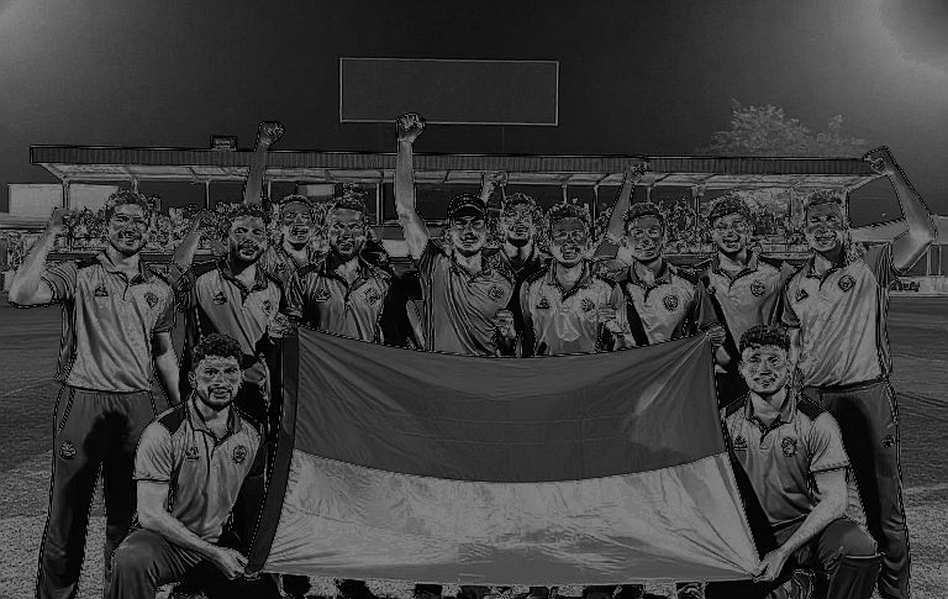
Three women sat at the edge of the mat, hands clasped tightly together. Not one of them dared to speak. Across the floor, Iran was performing their kata. Nguyen Ngoc Tram later revealed that during warm-up, her knee had been struck twice, swelling and grazing — yet she still walked onto the mat. When Vietnam's turn came, three bodies moved as if controlled by a single brain. And when the scoreboard appeared, all five judges pressed the same button: 5-0.
That was Vietnam's first gold medal at this edition of the continental Games. But the number truly worth analysing is not the medal itself. It is that five identical votes emerged — something that rarely happens in a discipline decided by human judgement of technical and physical merit.
To understand why this result matters, one must understand what kata is and how it differs from the common image of karate.
Most audiences, upon hearing the word "karate", immediately think of fighting exchanges, punches, sparks of collision. That is kumite — direct combat, with weight divisions and referees awarding points for landed strikes. Kata is an entirely different world. It is a choreographed sequence of movements, performed in team formation, and judged by a panel applying technical and athletic criteria.
No opponent punches your face. No extra rounds. No knockout. Only precision, synchronisation, power, rhythm, breathing, and what specialists call "kime" — the decisiveness within each moment.
The rules are governed by the World Karate Federation (WKF). Each team performs, and a panel — in this case five judges — delivers a verdict. Nobody counts landed strikes. What is measured is the persuasiveness of an entire moving composition.
The context of this final carried another layer: Vietnam entered as defending champion. That means the pressure was not merely to win gold, but to protect gold. With a three-person lineup — Nguyen Ngoc Tram, Bui Ngoc Nhi, Hoang Thi Thu Uyen — cohesion cannot be built in a few weeks. It accumulates across training cycles, across shared appearances on the mat, across failures and corrections.
Their opponent, Iran, is no weak side. Iran is one of Asia's kata powers. No specific ranking data appears in the source, but their tradition in this discipline is undeniable.
So what created the 5-0 gap?
The first key point lies in the order of performance. Vietnam performed after Iran. This is a measurable psychological advantage. When you sit outside and watch your opponent perform, you have a benchmark to aim at. You know what you must surpass. In a panel-judged discipline, having a "reference point" before stepping onto the mat is a far greater advantage than performing first and then waiting for the verdict.
But order advantage only matters if the team can execute. And this is where ritual enters.
Ngoc Tram recounted that before competing, all three women were so tense that none dared to speak. That state — silence before the storm — signals extreme pressure. Their method of handling it was not to say "calm down", but to perform a physical ritual: holding hands and regulating breath. This is a collective psychological synchronisation technique, turning three individuals into one shared breath.
In team kata, synchronisation is not merely technical. It is physiological. If three people breathe at different rhythms, movements drift. If heart rates differ, decisiveness differs. Holding hands and regulating breath together immediately before stepping out is a way of returning three bodies to the same physiological state before committing them to the same sequence of movement.
This explains why the gap was so clear. When a team achieves synchronisation at that level, the judging panel — trained to detect rhythm deviation of even a fraction of a second — sees a complete picture. When that picture is whole, there is little room for hesitation.
Five judges pressed the same button. This is the strongest signal in the entire story.
In scored disciplines, judging panels tend to split when two performances are close in quality. One judge may favour power and speed. Another may prioritise subtlety and control. When the result is 5-0, it means the superiority did not rest on a contentious aspect, but on a whole in which every criterion aligned.
In other words, Vietnam did not win because one judge liked them. They won because all five could find no reason to score lower.
This matters because kata is a discipline where results are often doubted. Judging subjectivity is an inherent feature of any performance-based sport. At major events, narrow decisions often trigger disputes lasting years. Here, no dispute was recorded. The result stands firm.
One more detail deserves its proper place: Ngoc Tram's injury.
She struck her knee twice during warm-up, causing swelling and grazing. It was an acute, minor injury but a meaningful one. It says two things. First, this is a sport that places significant load on knees, hips and ankles, through repeated deep stances and high-torque rotation. Second, an injury occurring during warm-up is a signal about training management — whether warm-up protocol or mat conditions.
That Ngoc Tram still competed and won gold shows remarkable mental endurance. Based on my experience tracking matches across different disciplines, an athlete who has just suffered an injury but still steps onto a final mat usually reflects one of two things: either exceptional individual character, or a lack of squad depth. This is not criticism. It is a structural observation.
There is a misreading I want to warn against.
One could look at the 5-0 score and conclude Vietnam overwhelmed Iran comprehensively, like a boxing bout where a fighter wins all five rounds. That comparison is wrong in nature.
In boxing, a 50-45 score means a fighter landed more, inflicted more damage, controlled more of the fight — a measure of physical domination. In kata, 5-0 does not measure physical domination. It measures consensus on technical and artistic merit. It is unanimity, not annihilation.
Iran's 0-5 loss does not mean Iran is weak. In kata, unanimous verdicts usually reflect a gap in refinement on a specific day, not a structural mismatch. Iran remains a power in Asian kata. They lost because that day, three Vietnamese women reached a state that cannot always be reproduced.
The broader context of the discipline deserves a mention. Karate was added to the Olympic programme at Tokyo 2026, then removed for Paris 2026 and Los Angeles 2028. That fragile Olympic standing makes continental Games and World Championships the primary stage. A gold medal at a continental arena therefore carries far greater weight than a medal alone.
That is also why the reward story is notable. The bonus for this gold medal, according to the source, was approximately 1.2 billion VND, drawn from state budget and socialised sources. That figure reflects a state-led incentive model, entirely distinct from the prize economy of professional sports.
But the nature of that reward should be examined honestly. It is a one-off income, not recurring income. Split evenly across three athletes, it is not enough to build a career. For an amateur Olympic-track sport, the greatest post-retirement risk is not injury, but an income gap.
So what remains once the scoreboard goes dark?
There is a question I always carry when following scored disciplines: can a perfect moment be reproduced? With kata, the answer lies in the fact that perfection is not a state, but a moment created by preparation, synchronisation and a measure of physical fortune.
Five unanimous votes are a beautiful signal. But the real challenge lies ahead: how to turn a moment into a system, and how to give those who created it a future worthy of the moment they offered.
Cầu thủ liên quan
Bài nổi bật
A Referee Died From a Head-Drop in Mexico: Where Nobody Has the Power to Suspend a Wrestler2026-10-27
The Empty Cell in V.League's Transfer Data Sheet2026-10-23
Three Kinds of Historical Distortion in Jin Yong's Novels, and the Gap Vietnamese Martial Arts Has Yet to Fill2026-10-23
Jimmie Rivera stops Meyer at BKFC 95: 13 centimetres of height and a gulf in class2026-10-21
Muay Opens the 2026 National Sports Festival: the Men's Table Stops at 63.5 kg2026-10-19
Jena Bishop and the PFL Flyweight Crown: When a Single 10-8 Round Nearly Erased a Champion2026-10-18
Vietnamese Combat Sports Are Missing a Ledger: Injuries, Weight Cuts and the Data Void2026-10-17
El Búho, the 75-Year-Old Referee, and the Blow That Exposed the Cracks in Mexico's Independent Wrestling Circuit2026-10-14
Bài đề xuất
The Inam Butt File: A Late-Filed TUE and the Price of Strict Liability2026-09-16
Vietnamese Martial Arts and the Gap in the Classification Sheet2026-09-11
UFC 332: The Record 9 First-Round Knockouts and What the Stat Sheet Doesn't Say2026-10-04
The Night in Mineral de la Reforma: When a Wrestling Move Became a Case File, and the File Closed With a Cheque2026-10-14
3,900 Words Without a Single Fighter: Does Vietnamese Martial Arts Lack Data or the Courage to Say 'Not Enough'?2026-09-09
5-0 Against Iran, 0-5 Against Japan: Two Margins That Reveal Vietnam's Real Karate Strength2026-09-25
The Media Bubble Bursts, But the Sound Is Faint: When Japanese Martial Arts Fool Themselves with Empty Analysis2026-09-10
Three Scoring Systems Under One Label: Why Martial Arts Coverage Misreads the Ring2026-10-24
Bài đề xuất
Nguyen Thien Phung, the one keeping rhythm behind Vietnam's two poomsae world golds2026-09-18
ASIAD 2026: Vietnam's Women's Karate Kata Opens the Gold Account as a Rebuilt Squad Defends No. 1 in Asia2026-10-10
The Las Vegas Killing and the $382,928 Judgment Buried Under the Word 'Mogul'2026-10-21
The Slam in Mineral de la Reforma: A Move's Name, Age 75, and a Case Closed by Payment2026-10-14
When the Combat Sports Report Comes Back Empty: Data Discipline for Vietnamese Martial Arts2026-10-06
3,900 Words Without a Single Fighter: Does Vietnamese Martial Arts Lack Data or the Courage to Say 'Not Enough'?2026-09-09
VAR in V.League: 214 Referee Errors, 172 Interventions, and Lessons from the Operations Room2026-09-13
Chau Ngoc Tuyet Sang, Virtual Taekwondo and Vietnam Taekwondo's Double Bet at Asian Games 20262026-09-28
Bài đề xuất
Jena Bishop and the PFL Flyweight Crown: When a Single 10-8 Round Nearly Erased a Champion2026-10-18
Jimmie Rivera stops Meyer at BKFC 95: 13 centimetres of height and a gulf in class2026-10-21
Vietnam wins first ASIAD gold: a leap up the Asian rankings, top 3 in Southeast Asia2026-09-22
Duong Thuy Vi at Asiad 20: 0.133 Points and the System Behind the Bronze Medal2026-09-24
Vietnamese Combat Sports Are Missing a Ledger: Injuries, Weight Cuts and the Data Void2026-10-17
Combat Sports and the Data Gap: When a Fight Record Has Nothing Left to Cross-Check2026-09-12
Detailed Sports Analysis: Insufficient Input Data2026-09-08
The Empty Dossier: When a Martial Arts Analysis Has Nothing to Analyze2026-09-13